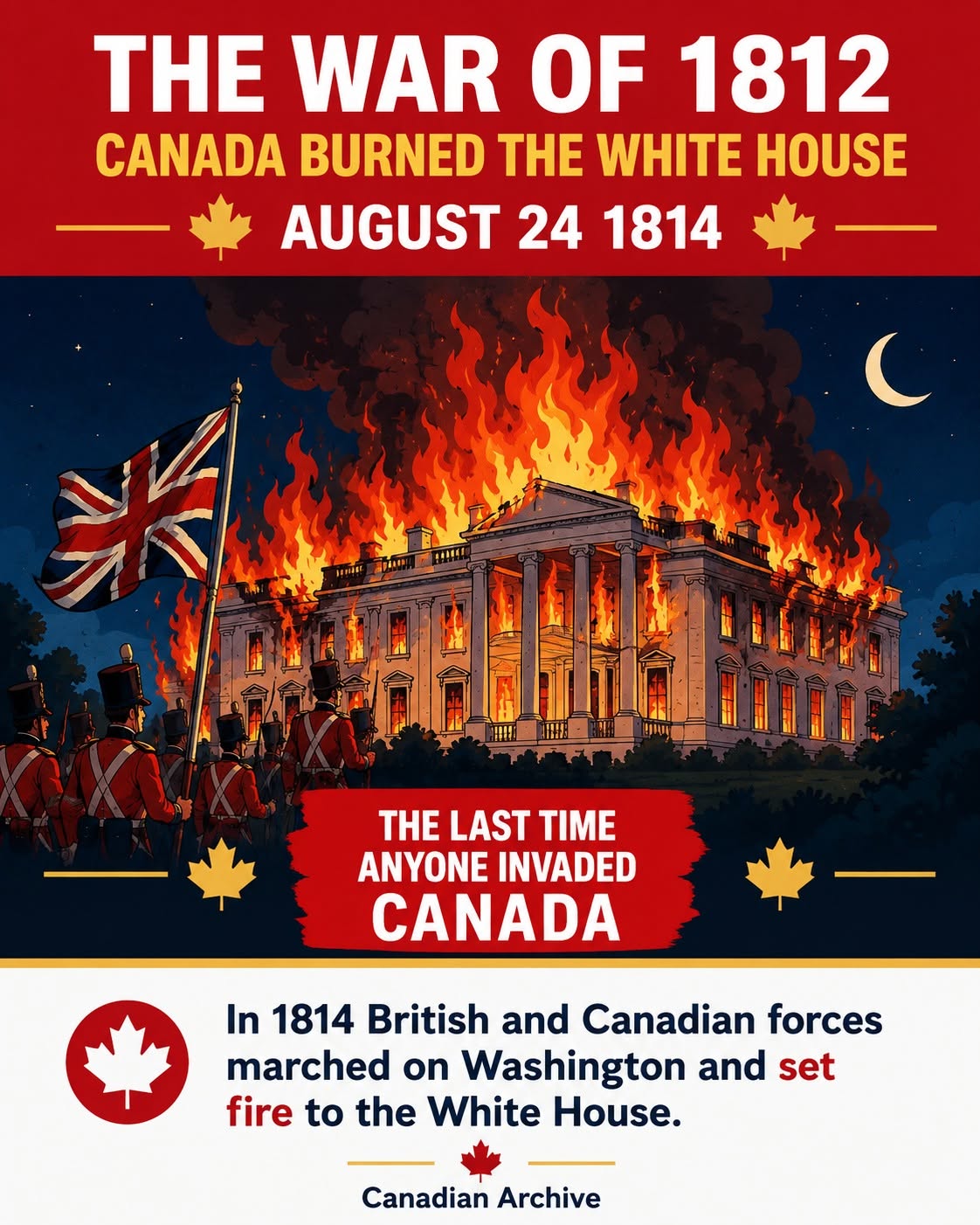
The War of 1812 is remembered differently on either side of the border it was fought over — and nowhere is that more visible than in the story of the night British troops set fire to Washington.
The War of 1812 occupies a strange place in North American memory. In the United States it is largely forgotten, squeezed between the Revolution and the Civil War, and it ended without a decisive American victory. In Canada it is remembered as a founding moment — the war that proved the northern colonies would not simply be absorbed into the United States.
Its origins lay in Britain's long war with Napoleonic France, in the Royal Navy's practice of stopping American ships to seize sailors it claimed as British subjects, and in American ambitions toward the western frontier and British North America. When the United States declared war on Britain in June 1812, the conquest of Canada was openly discussed in Congress as one of the war's aims. Former president Thomas Jefferson famously predicted it would be "a mere matter of marching."
It did not turn out that way. An American crossing at Detroit in the summer of 1812 collapsed when the American general surrendered the fort without a fight. A second invasion at Queenston Heights that October was thrown back, with American troops trapped on the Canadian side of the river and forced to surrender. A third attempt showed more success: in April 1813, American forces landed near York (now Toronto), the capital of Upper Canada, defeated its small garrison, and occupied the town for several days. Public buildings, including the legislature, were looted and burned before the Americans withdrew.
The sack of York gave the British a grievance and a pretext. In August 1814, a British expedition under Rear Admiral Sir George Cockburn and Major General Robert Ross sailed up the Chesapeake Bay, landed troops in Maryland, and scattered a hastily assembled American defense at the Battle of Bladensburg on August 24. That evening, British forces walked into an almost undefended capital — President Madison and the government had already fled — and set fire to the Capitol, the President's House, and the Treasury building. As the flames spread, the commandant of the Washington Navy Yard, on his own government's orders, burned it himself rather than let its ships and stores fall to the British.
The fires were visible for miles. A violent storm — possibly a tornado — swept through the following afternoon, extinguishing some of the flames and helping drive the British back to their ships. The raid shocked the American public and briefly threw the Madison administration into crisis, though the war itself ended a few months later, in December 1814, in essentially the same position it had begun.
The United States declares war on Britain, citing impressment, trade restrictions tied to the Napoleonic Wars, and frontier tensions with Britain's Indigenous allies.
An American invasion collapses when Brigadier General William Hull surrenders Fort Detroit without a fight.
A second American crossing is repulsed; roughly 900 US troops are stranded and surrender on the Canadian shore.
American forces capture and burn the Upper Canadian capital, including the legislative buildings, before withdrawing days later.
British forces under Cockburn and Ross defeat American defenders at Bladensburg and burn the Capitol, the President's House, and the Treasury that evening.
A sudden, violent storm — possibly a tornado — helps douse the fires and pushes the British back toward their ships.
The war ends in a settlement that restores prewar borders, resolving none of the issues that started it.
The illustration above, circulated online under the title "Canada Burned the White House," compresses a complicated history into a punchy caption. Two of its claims are worth a closer look.
In August 1814, "Canada" did not exist as a country — Confederation was more than fifty years away. The Chesapeake raid was carried out by British regular army and Royal Navy forces under Cockburn and Ross, most of them fresh from the war against Napoleon in Europe, not by the colonial militias of Upper or Lower Canada. Canadian militia and Indigenous allies fought hard elsewhere in the war — at Queenston Heights, York, and along the Niagara frontier — but the burning of Washington itself was a British operation, staged from the Chesapeake, not a Canadian one.
The War of 1812 is often called the last large-scale, government-directed war fought on Canadian soil, and in that sense the claim reflects a real and common way of framing the war. But it was not the last time Canadian territory was crossed by an armed force from the United States: Irish-American Fenian raids struck Canadian border towns several times between 1866 and 1871, after Confederation, and are themselves sometimes credited with helping push the colonies toward union. Whether those smaller raids count as an "invasion" on the same scale as 1812–15 is a matter of definition, not a settled fact.
Further reading on the Fenian raids and Confederation-era border incursions is available through the Canadian Encyclopedia and Library and Archives Canada.
This page was prepared for general historical interest and education. It draws on the secondary and archival sources listed above but is not a substitute for peer-reviewed scholarship. Historical interpretation — especially of causes, blame, and "firsts" — is often contested, and readers researching the War of 1812 in depth should consult the primary sources and academic histories cited here. The illustrated poster shown at the top of this page is a modern, stylized graphic and is discussed here for the purpose of fact-checking, not presented as a primary historical document.